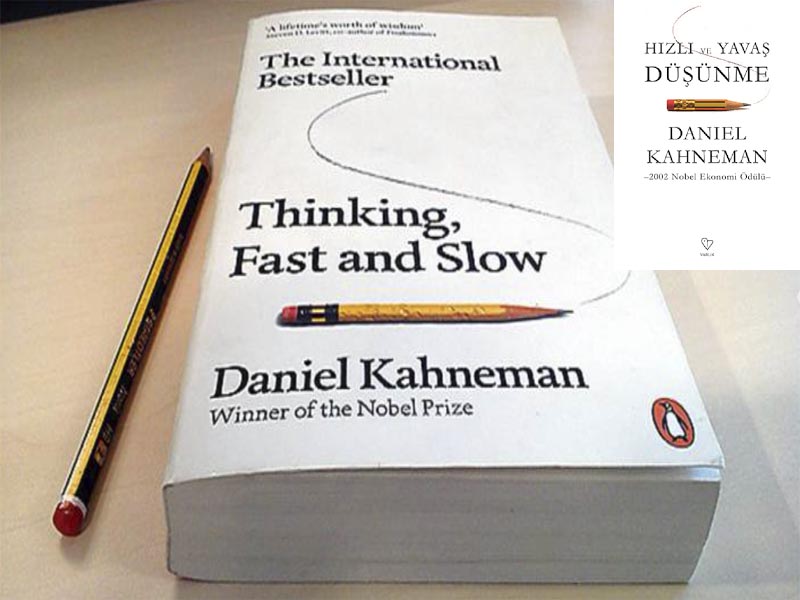
Thinking, Fast and Slow Summary: The Two Systems of the Mind. “The intuitive mind is a sacred gift and the rational mind is a faithful servant.” While Kahneman’s work challenges this old proverb, it reveals a startling truth: we are not the rational decision-makers we think we are. Thinking, Fast and Slow explores the two systems that drive the way we think and why our intuition often leads us into systematic errors.
1. Book Info: At a Glance
| Feature | Detail |
| Author | Daniel Kahneman (Nobel Laureate) |
| Main Themes | Behavioral Economics, Cognitive Psychology, Decision Making |
| Core Concepts | System 1 & System 2, Cognitive Biases, Loss Aversion |
| Genre | Non-Fiction / Science |
System 1 vs. System 2: The Two Operating Systems
Kahneman divides the brain’s thought processes into two distinct “characters”:
-
System 1 (Fast Thinking): This system is automatic, emotional, and requires little to no effort. It’s what allows you to read a person’s facial expression or solve 2+2 instantly. It operates on “autopilot.”
-
System 2 (Slow Thinking): This system is logical, calculative, and demands energy. It is used for complex math problems, filling out a tax form, or focusing on a single voice in a crowded room.
The Conflict: System 2 is “lazy.” It often accepts the easy answers provided by System 1 without questioning them, which is where most cognitive errors occur.
WYSIATI: What You See Is All There Is
This is one of the most famous acronyms in the book. System 1 is a “storyteller” that jumps to conclusions based on limited information.
-
The Illusion of Understanding: If you see a politician being charismatic, System 1 immediately decides they are also honest and competent, despite having no data on their performance.
-
Consistency over Completeness: Our brains value a coherent story over a complete set of facts.
Why We Make Bad Choices: Common Biases
-
Anchoring Effect: We rely too heavily on the first piece of information we receive (the “anchor”). For example, seeing a $1,000 price tag makes a $500 sale seem like a bargain, regardless of the product’s actual value.
-
Loss Aversion: The pain of losing $100 is twice as powerful as the joy of gaining $100. This leads people to take irrational risks to avoid losses while being overly cautious with gains.
-
The Sunk Cost Fallacy: We continue to invest time or money into a losing project (or a bad relationship) simply because we’ve already spent so much, ignoring the reality that the “cost” is already gone.
The Two Selves: Experiencing vs. Remembering
Kahneman introduces a groundbreaking distinction in how we perceive happiness:
-
The Experiencing Self: Lives in the moment. It asks, “How do I feel right now?”
-
The Remembering Self: Keeps score. It asks, “How was the experience overall?”
The Peak-End Rule: We don’t remember an entire experience; we only remember the peak (the best or worst moment) and the end. A long, pleasant vacation can be “ruined” in our memory by a single bad flight on the last day.
Key Takeaways for Busy Readers
-
Engage System 2: When making life-altering decisions, don’t trust your “gut.” Force yourself to look at the statistics.
-
Beware of Framing: Always ask, “How is this information being presented to me?” (e.g., 90% fat-free vs. 10% fat).
-
Admit Ignorance: We often overestimate how much we understand the world and underestimate the role of luck.
FAQ
-
What is the main point of Thinking, Fast and Slow? Our minds are prone to systematic errors (biases) because we rely too much on fast, intuitive thinking rather than slow, logical analysis.
-
Can we switch off System 1? No. System 1 is always running. The goal is to learn to recognize situations where it is likely to lead us astray and call in System 2 for help.
🧠 The Master Decision-Maker’s Checklist
Before making a major life or financial decision, run your thoughts through this System 2 filter to avoid common cognitive traps:
1. Is System 1 Running the Show?
-
Ask yourself: Am I making this choice because it feels right (intuition) or because the data supports it?
-
Action: Take a 10-minute break. System 1 is impulsive; System 2 needs time to wake up.
2. Beware of the “Anchor”
-
Ask yourself: Am I focusing too much on the first number or piece of information I heard?
-
Action: Research the “market average” or seek a second opinion that starts from a different baseline.
3. Check for WYSIATI (What You See Is All There Is)
-
Ask yourself: What information am I not seeing right now?
-
Action: Write down three reasons why this decision might be wrong. This forces your brain to look for missing evidence.
4. Evaluate the “Frame”
-
Ask yourself: Would I make the same choice if the situation was described differently?
-
Example: If a project has a “70% chance of success,” would I still do it if someone said it has a “30% chance of failure”?
5. Avoid the Sunk Cost Trap
-
Ask yourself: If I were starting fresh today with zero prior investment, would I still put money/time into this?
-
Action: If the answer is “No,” it’s time to cut your losses and move on.
6. The “Outside View” Test
-
Ask yourself: How long does this usually take for other people?
-
Action: Ignore your personal optimism. Look at the statistics of similar cases to get a realistic timeline and budget.