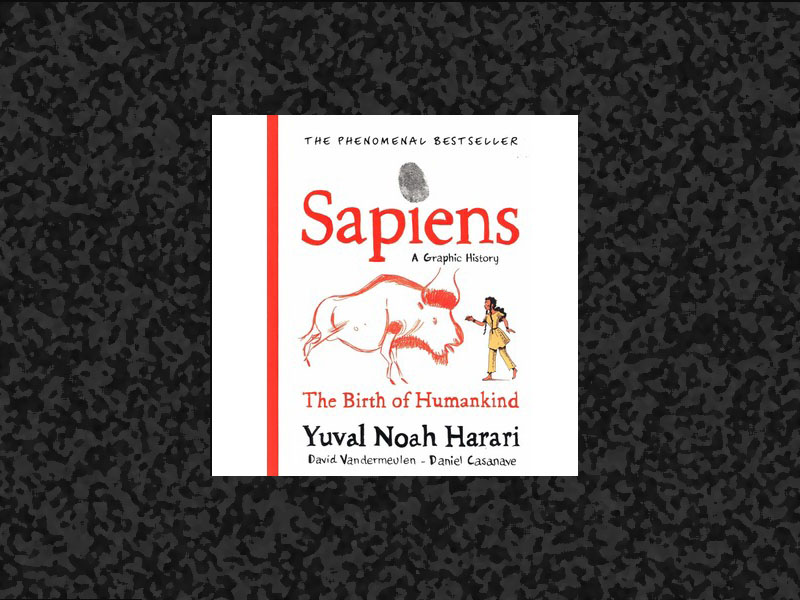
Sapiens Book Summary: A Brief History of Humankind. Dive into Harari’s Sapiens. Learn how money, religion, and the “discovery of ignorance” shaped human history. The most detailed analysis of the human story.
At a Glance: Key Concepts
| Feature | Detail |
| Author | Yuval Noah Harari |
| Main Thesis | Sapiens rule the world because we can believe in “fictions.” |
| The Three Revolutions | Cognitive, Agricultural, and Scientific |
| Key Pillars | Money, Religion, and Empires |
Introduction: The Animal that Became a God
100,000 years ago, at least six human species inhabited the earth. Today, only one remains: Homo Sapiens. How did an insignificant animal in the middle of the food chain become the master of the planet? Harari argues that our secret weapon wasn’t our individual intelligence or tool-making skills, but our ability to cooperate flexibly in large numbers by believing in shared myths.
The Unification of Humankind
For centuries, human cultures were fragmented. Harari identifies three universal “imagined orders” that brought the world together:
A. Money: The Most Universal Myth
Money is not a material reality; it is a psychological construct.
-
The Concept of Trust: Money is the only thing everyone trusts. Even enemies who don’t believe in the same God or King will accept the same gold or currency.
-
Universal Convertibility: Money allows us to turn anything into anything else (e.g., turning “physical labor” into “digital bytes” and then into “bread”).
-
The Psychological Revolution: Money is the most tolerant system ever created, as it doesn’t care about race, religion, or gender—only about value.
B. Religion: Sanctifying the Imagined Order
Religion provides a superhuman legitimacy to the laws and structures created by humans.
-
Legitimizing Rules: Humans are fragile, but if you claim a law was given by a God, it becomes unshakeable.
-
The Evolution of Faith: Harari tracks religion from Animism (everything has a spirit) to Theism (Gods control the world) and finally to Humanism (Man is the center of the universe).
-
Modern Religions: Harari argues that ideologies like Capitalism, Nationalism, and Socialism are “modern religions” because they rely on shared dogmas and fictions rather than biological facts.
The “Fraud” of the Agricultural Revolution
In one of the book’s most controversial sections, Harari calls the transition from hunting and gathering to farming “History’s Biggest Fraud.”
-
The Wheat Trap: We didn’t domesticate wheat; wheat domesticated us. It forced humans to settle in permanent spots, work longer hours, and suffer from new diseases and back pain.
-
Luxury Trap: Every “convenience” we invent eventually becomes a necessity that burdens us with more work.
The Scientific Revolution: The Discovery of Ignorance
The modern age began when humans admitted they didn’t know everything.
-
The Power of “I Don’t Know”: Admitting ignorance allowed for exploration and scientific discovery.
-
The Alliance of Science & Empire: Science gave empires the technology to conquer, while empires gave science the funding and data to progress.
The End of Sapiens: Homo Deus
We are now entering a phase where “Intelligent Design” is replacing natural selection.
-
Bio-engineering: We are rewriting genetic codes.
-
Cyborgs: We are merging our bodies with inorganic parts.
-
The New God: Sapiens are on the verge of upgrading themselves into a new species entirely—one with god-like powers but perhaps without a sense of purpose.
Key Takeaways for the Reader
-
Biology enables, Culture forbids: Biology defines what is possible; culture defines what is “natural” or “unnatural.”
-
There is no justice in nature: Concepts like “rights” and “equality” are brilliant fictions we created to coexist.
-
Power does not equal happiness: We have 1000x more power than our ancestors, but are we any happier?
Gossip Theory: Why Did Our Language Evolve?
According to Harari, the primary driver for the evolution of our language wasn’t philosophy or science—it was gossip.
-
Social Cooperation: In groups of up to 150 individuals, knowing who is trustworthy and who is sleeping with whom is vital for survival.
-
Fictional Language: What truly sets Sapiens apart isn’t just saying, “Look, a lion!” but saying, “The lion is the guardian spirit of our tribe.” This allows thousands of strangers to cooperate under the same flag or belief system.
The Agricultural Revolution: Were We Domesticated?
Harari titles this chapter “History’s Biggest Fraud” and presents a highly controversial claim:
-
The Victory of Wheat: Hunter-gatherers once ate hundreds of types of plants and worked only about 4 hours a day. With agriculture, humans became enslaved to a single crop (wheat, rice, or corn).
-
The Biological Price: The human body did not evolve to spend all day bending over in fields; this shift brought about slipped discs and joint pain.
-
Conclusion: Agriculture produced more food, but it didn’t create happier people—it created more crowded, overworked, and poorly nourished societies.
The Unifiers of History
Harari details the three fundamental elements that transformed small tribes into massive empires:
-
Money (Economic Unity): The one thing everyone trusts. Even two enemy kings will trust each other’s gold.
-
Empires (Political Unity): They dissolve diverse cultures into a single language and legal system, creating periods of great peace (Pax).
-
Religions (Social Unity): They sanctify the “imagined order,” providing legitimacy to human laws.
The Scientific Revolution & Modern Empires
The spark of the Scientific Revolution wasn’t technology; it was the “Discovery of Ignorance.”
-
The Blank Spots: Europeans began leaving blank spaces on their maps, admitting, “I don’t know.” This desire to explore the unknown brought science and imperialism (colonialism) together.
-
The Alliance: Science provided empires with technology, while empires provided science with funding and data.
Capitalism: The Religion of Infinite Growth
Harari argues that Capitalism is not just an economic system, but the most successful “religion” in history:
-
Credit and Trust: The belief that the “future pie” will be larger than the current one creates the credit system.
-
Consumer Culture: In the modern world, “doing good” has become synonymous with “consuming.” While the rich once lived in luxury and the poor saved, now the rich invest and the poor/middle class go into debt to consume.
The End of Sapiens: Intelligent Design
The most shocking final chapter: “Intelligent Design” is replacing the law of natural selection.
-
Bio-engineering: We are editing genetic codes to eliminate diseases and extend life.
-
Cyborgs: We are merging the human body with inorganic parts (chips, prosthetics).
-
Artificial Intelligence: We are designing entirely inorganic entities that could eventually replace Sapiens.
Money: The Universal Form of Mutual Trust
Harari claims money is the most efficient “collective imagination” in history. It has no physical reality, yet everyone believes in it.
-
Universal Trust: It allows two strangers of different faiths to cooperate. A Muslim merchant can trust a coin minted by a Christian because he knows a Jew will also value it.
-
Convertibility: Money is the bridge between “apples” and “legal advice.” Everything becomes exchangeable.
-
Psychological Revolution: Money is a mental construct, not a piece of paper. Harari calls it “the most tolerant system ever created” because it only cares about value, not race or gender.
Religion: Sanctifying the Imagined Order
Harari defines religion as a system that provides superhuman legitimacy to human-made rules.
-
Legitimizing Laws: Human laws are fragile, but claiming “God gave us these laws” makes them unshakeable.
-
Mass Cooperation: After the Cognitive Revolution, religion allowed Sapiens to form armies and cities of thousands around shared rituals.
Types of Religion According to Harari
-
Animism: Everything (trees, rocks) has a soul. Man is part of nature.
-
Theism: Gods rise, and humans make “deals” with them to exploit nature.
-
Humanism (Modern Religions): “Humanity” has replaced “God.” Nationalism and Socialism are “modern religions” because they rely on fictional dogmas rather than biological facts.
💡 Key Takeaways from Sapiens
-
Shared Myths: The secret to Sapiens’ global dominance is our unique ability to believe in “imagined orders” like money, religion, and human rights.
-
The Power of Cooperation: We are the only species that can cooperate flexibly in massive numbers (millions), even with complete strangers.
-
The Wheat Trap: The Agricultural Revolution wasn’t necessarily a “progress” for individuals; it led to longer work hours, more disease, and social inequality.
-
Money is Trust: Money is the most successful and tolerant “religion” ever created, as it is the only thing that can bridge the gap between people of different faiths.
-
Scientific Revolution: Modern progress began when we admitted our ignorance (“The Discovery of Ignorance”) and combined science with political and economic power.
-
End of Natural Selection: We are shifting from natural selection to “Intelligent Design” (Bio-engineering & AI), which may eventually lead to the end of the Sapiens species as we know it.