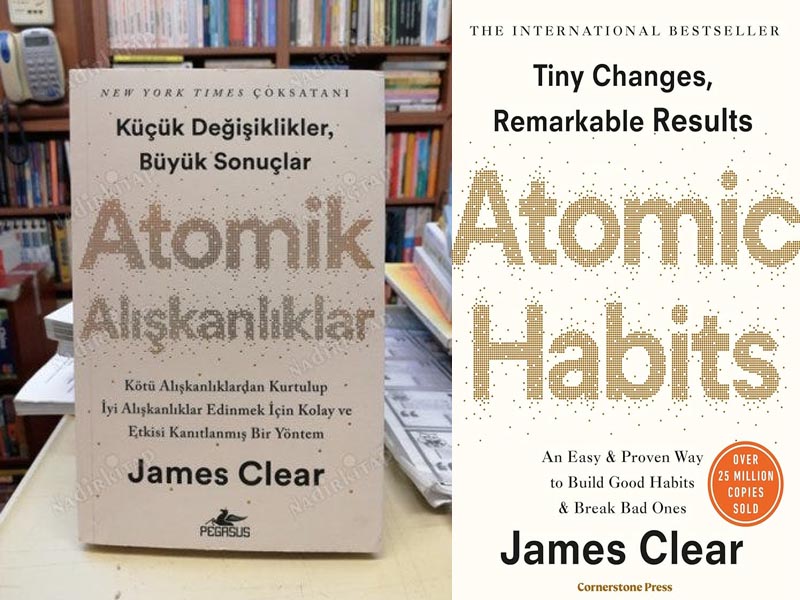
Atomic Habits Summary Guide : A Comprehensive Guide to Change with James Clear. “You do not rise to the level of your goals; you fall to the level of your systems.” This profound insight from James Clear’s Atomic Habits has redefined personal development. Success is not about a single “big break”; it is about the mastery of the tiny, 1% improvements we make every day.
1. The Power of 1%: The Math of Compounding
Most people underestimate the power of small changes. However, if you improve by just 1% every day, you will be 37 times better by the end of a year. Conversely, if you get 1% worse, you will decline almost to zero.
-
The Plateau of Latent Potential: Habits often show no results for a long time until you cross a critical threshold. This is why many people quit; they are in the “Valley of Disappointment.”
-
Focus on Systems, Not Goals: Goals are about the results you want to achieve. Systems are about the processes that lead to those results.
2. Identity-Based Habits: The Core of Change
The most effective way to change your habits is to focus not on what you want to achieve, but on who you wish to become.
-
Outcome-based: “I want to run a marathon.”
-
Identity-based: “I am a runner.”
-
The Depth: Every time you go for a run, you are casting a vote for the identity of a runner. True behavior change is actually identity change.
3. The Four Laws of Behavior Change
To build better habits (and break bad ones), James Clear provides a simple 4-step framework based on the habit loop:
| Law | Stage | How to Create a Good Habit | How to Break a Bad Habit |
| 1st Law | Cue | Make it Obvious | Make it Invisible |
| 2nd Law | Craving | Make it Attractive | Make it Unattractive |
| 3rd Law | Response | Make it Easy | Make it Difficult |
| 4th Law | Reward | Make it Satisfying | Make it Unsatisfying |
4. Key Strategic Tactics
The 2-Minute Rule
“When you start a new habit, it should take less than two minutes to do.”
-
Example: Don’t “Read 30 pages”; instead, “Read 1 page.” Once you start doing the right thing, it is much easier to continue doing it.
Habit Stacking
The best way to build a new habit is to tie it to an existing one.
-
Formula: “After [Current Habit], I will [New Habit].”
-
Example: After I pour my morning coffee, I will meditate for one minute.
Environment Design
Visual cues are the greatest catalysts of our behavior.
-
The Strategy: If you want to drink more water, put water bottles all around your house. If you want to play guitar more, put it in the middle of the living room.
5. Strategic Takeaways: The Neurology of Success
-
The Goldilocks Rule: We stay motivated when we tackle tasks that are just at the edge of our ability (not too easy, not too hard).
-
Never Miss Twice: Missing once is an accident. Missing twice is the start of a new habit. If you fail, get back on track immediately.
🛠️ English Habit Tracker: The 1% Progress Log
| Date | Habit 1 (2-Min Version) | Habit 2 (Stacking) | Habit 3 (Environment) | Daily Win? |
| Mon | ✅ | ✅ | ✅ | ⭐ |
| Tue | ✅ | ❌ | ✅ | 🆗 |
| Wed | ✅ | ✅ | ✅ | ⭐ |
Atomic Habits: Small Changes, Remarkable Results. According to James Clear, the problem isn’t you; it’s your system. You do not rise to the level of your goals; you fall to the level of your systems. This is a deep dive into building habits that actually stick.
🔬 The Core Philosophy: The 1% Rule and Compounding
Most people think that massive success requires massive action. Clear proves the opposite: Atomic Habits.
-
Compound Effect: If you get just 1% better each day, you will end up 37 times better by the end of the year. Habits are the “compound interest” of self-improvement.
-
The Plateau of Latent Potential: Change is often non-linear. Like an ice cube that doesn’t melt until it reaches 0°C (after being warmed from -5°C), habits require a breakthrough point where the accumulated effort finally becomes visible.
🔍 Deepened Strategic Insights: The Neurology of Change
To truly master your behavior, you must understand the underlying psychological layers:
1. Identity-Based Habits: The Ultimate Vote
Most people focus on what they want to achieve (Outcomes). Successful people focus on who they wish to become (Identity).
-
Deep Insight: Every action you take is a “vote” for the type of person you wish to be. Doing one push-up doesn’t transform your body, but it casts a vote for the identity of “someone who doesn’t miss a workout.”
-
Application: Stop asking “What result do I want?” and start asking “What would a healthy/productive/creative person do right now?”
2. The Goldilocks Rule: Staying in the Zone
The human brain loves a challenge, but only if it is within the optimal zone of difficulty.
-
Deep Insight: We experience peak motivation when working on tasks that are right on the edge of our current abilities—specifically, about 4% beyond our current limit. Too easy, and we get bored; too hard, and we experience anxiety.
-
Application: Constantly “nudge” your habits forward just enough to stay engaged without burning out.
3. Social Norms and The Invisible Hand
We don’t choose our earliest habits; we imitate them from our culture and family.
-
Deep Insight: One of the most effective ways to build better habits is to join a culture where your desired behavior is the normal behavior. * Application: Surround yourself with people who already have the habits you want. The shared identity of the group reinforces the individual habit.
🧩 The 4 Laws of Behavior Change
Clear breaks habits into a 4-step loop. To create a good habit, follow these laws:
-
Cue: Make it Obvious. Use “Habit Stacking” (After [Current Habit], I will [New Habit]).
-
Craving: Make it Attractive. Use “Temptation Bundling” (Pair what you need to do with what you want to do).
-
Response: Make it Easy. Use the 2-Minute Rule (Any new habit should take less than 2 minutes to start).
-
Reward: Make it Satisfying. Use a habit tracker to provide immediate visual evidence of progress.
🛠️ Atomic Habit Tracker Template
Use this template to provide the “visual proof” your brain needs to maintain a new identity.
Weekly Habit Scorecard
| Habit (Atomic Version) | Mon | Tue | Wed | Thu | Fri | Sat | Sun |
| Read 1 page (2-min rule) | ✅ | ✅ | ✅ | ❌ | ✅ | ✅ | ✅ |
| 5 Push-ups (Start small) | ✅ | ✅ | ✅ | ✅ | ❌ | ✅ | ✅ |
| Drink 2L Water (Make it easy) | ✅ | ✅ | ❌ | ✅ | ✅ | ✅ | ✅ |
The Habit Design Card (Implementation)
-
Implementation Intention: I will [Behavior] at [Time] in [Location].
-
Habit Stacking: After I [Current Habit], I will [New Habit].
-
Environment Design: I will make [Cue] obvious by [Action] (e.g., placing my book on my pillow).
-
The Emergency Rule: Never miss twice. If you miss a day, get back on track immediately.
💡 Pro-Tip: Mastering the “Art of Showing Up”
The goal of a habit tracker is not perfection; it is consistency. Even on a bad day, doing a “2-minute version” of your habit (e.g., putting on your running shoes and walking to the door) is a victory because it keeps the identity alive.