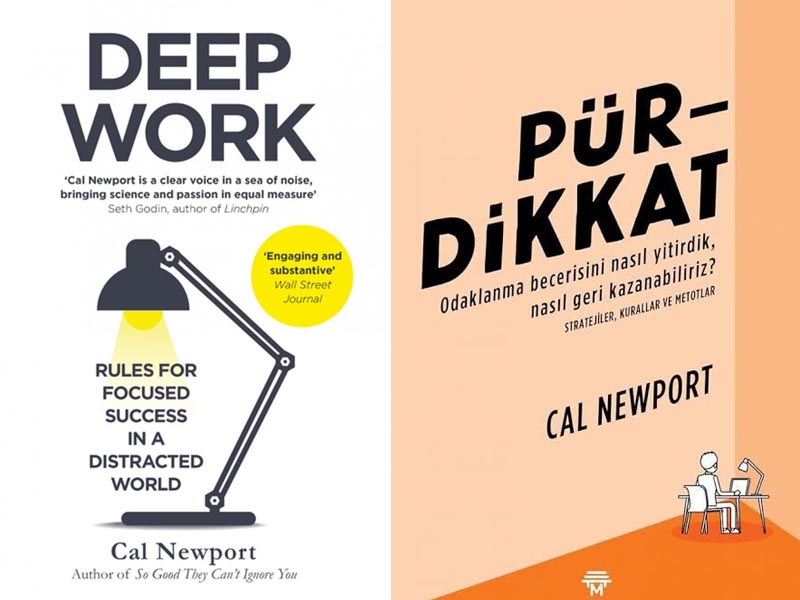
Deep Work Summary Guide : Rules for Focused Success in a Distracted World . “In an economy where distraction is a currency, the ability to focus deeply is a superpower.” Cal Newport’s “Deep Work” is more than a productivity book; it is a strategic blueprint for anyone who wants to produce at an elite level.
🔬 The Core Philosophy: Deep vs. Shallow
Newport divides all professional activities into two distinct categories:
-
Deep Work: Professional activities performed in a state of distraction-free concentration that push your cognitive capabilities to their limit. These efforts create new value, improve your skill, and are hard to replicate.
-
Shallow Work: Non-cognitively demanding, logistical-style tasks, often performed while distracted (e.g., answering emails, attending unnecessary meetings, checking Slack). These efforts tend to not create much new value in the world and are easy to replicate.
The Strategic Reality: Our culture is shifting toward shallow work, which means those who cultivate the ability for Deep Work will become increasingly rare and valuable.
🧠 The Science of Focus: Attention Residue
Why is “multi-tasking” a myth? The answer lies in Attention Residue.
-
The Theory: When you switch from Task A to Task B, your attention does not follow immediately. A “residue” of your attention remains stuck on the previous task.
-
The Impact: If you check your phone or inbox every 10-15 minutes, you are working with a fragmented brain. You never reach the “Deep State” required for elite output because your cognitive resources are constantly divided.
🛠️ The 4 Rules for Deep Work
To integrate depth into your life, you must move beyond good intentions and build rigorous rituals.
Rule #1: Work Deeply
Choose a philosophy that fits your life:
-
The Rhythmic Approach: Carving out a regular time every day (e.g., 5 AM – 8 AM) for deep work. This is the most effective for most professionals.
-
The Bimodal Approach: Dividing your time into clearly defined stretches of deep and shallow work (e.g., 3 days for deep work, 2 days for meetings).
Rule #2: Embrace Boredom
The ability to concentrate is a muscle that must be trained. If every moment of potential boredom (waiting in line, sitting in an elevator) is relieved by your smartphone, your brain will be “wired” for distraction.
-
The Strategy: Practice being bored. Allow your mind to wander without digital input to strengthen your focus muscle.
Rule #3: Quit Social Media
Do not use tools just because they offer “some benefit.” Apply the “Critical Few” rule: Only use a tool if its positive impacts on your core goals significantly outweigh its negative impacts.
Rule #4: Drain the Shallows
Schedule every minute of your day. By giving every hour a job, you become aware of how much time you waste on “shallow” tasks that feel like work but don’t produce results.
📊 Deep Work Session Blueprint
| Phase | Goal | Key Action |
| I. Setup | Minimize Friction | Clear desk, phone in another room, specific “focus” playlist. |
| II. Intent | Define Success | Set a concrete goal: “Finish 3 pages” not “Work on report.” |
| III. Depth | Cognitive Push | Focus exclusively for 90 minutes. No browser tabs except the essentials. |
| IV. Close | Shutdown Ritual | Review tasks, plan for tomorrow, and say “Shutdown complete.” |
🔍 Deep Strategic Insight: The Myelin Connection
Deep work is the fastest path to skill acquisition. By focusing intensely on a single task, you trigger myelination—the process of strengthening neural pathways. You are literally re-wiring your brain to be more elite at the skill you are practicing.
Here is the professional English version of the Deep Work Session Design guide. This guide integrates the “Meaning” of Frankl, the “Strategy” of Covey, and the “Atomic Steps” of Clear into a single, high-performance ritual.
Deep Work Session Design: A Step-by-Step Guide. Deep work is not a matter of willpower; it is a matter of design. To transform your brain into a laser beam of productivity, you must move beyond “trying to focus” and start “structuring focus.” Here is your 4-phase ritual for cognitive excellence.
Phase 1: Environment and Boundaries (The Sanctuary)
You need a physical trigger that signals to your brain: “We are entering the Deep State.”
-
The Sacred Space: Dedicate a specific desk, chair, or room solely to deep work.
-
The Inaccessibility Rule: Physically leave your phone in another room. Use website blockers (like Freedom or Cold Turkey) to shut down every tab except the one essential for your task.
-
Sensory Triggers: Put on noise-canceling headphones or start a specific “Focus” playlist (Lo-fi, white noise, or classical). Use these only during deep sessions.
Phase 2: Goal and Duration (The Scope)
Ambiguity is the greatest enemy of concentration.
-
Set the Timer: Choose a block of 60 to 90 minutes. The human brain typically experiences a decline in focus after 90 minutes.
-
Define the Output: Do not say, “I will work on the project.” Instead, say: “I will write 800 words of the introduction” or “I will debug the login authentication module.” The more concrete the goal, the sharper the focus.
Phase 3: The Launch Ritual (Cognitive Priming)
Perform a transition ceremony to disconnect from the “shallow world.”
-
The Warm-up: Prepare a cup of coffee or tea. This simple repetitive act primes the brain for work.
-
Brain Dump: If you are worried about minor tasks (paying a bill, replying to a text), write them down on a physical notepad and tell yourself: “I will not think about these until the session is over.”
-
The Start Signal: Take three deep breaths, open your primary document, and begin.
Phase 4: The Shutdown Ritual (Recharge)
Deep work consumes immense cognitive energy. You must protect your ability to recover.
-
Save and Log: Save your work and write down exactly where you will start in the next session (this lowers the “activation energy” for tomorrow).
-
The Verbal Cue: Say a specific phrase out loud, such as “Shutdown complete” or “Session finished.” This tells your brain it is safe to stop processing work.
-
Active Recovery: Do not jump straight to your phone. Walk, stretch, or look out the window for 5 minutes to let the new information neurologically consolidate.
📊 Deep Work Session Planner (Template)
| Step | Action | Completed? |
| Preparation | Phone in another room; browser tabs restricted. | [ ] |
| Ritual | Coffee/Tea ready; focus music active. | [ ] |
| Objective | “I will finish [Specific Task] in 90 minutes.” | [ ] |
| Closure | Progress logged; shutdown verbalized. | [ ] |
💡 Strategic Insight: “The Boredom Muscle”
The quality of your deep sessions is determined by what you do during your shallow hours. If you constantly stimulate your brain with your phone while waiting in line or sitting in a car, you are training your brain to crave distraction. Embrace boredom. A brain that can handle silence is a brain that can produce masterpieces.