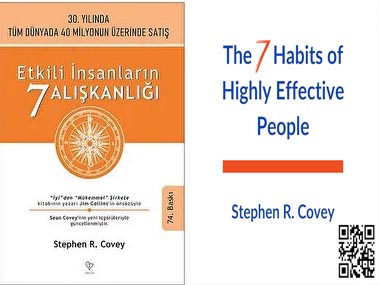
The 7 Habits of Highly Effective People: A Character-Based Guide to Success
True success is not a matter of luck or fleeting techniques; it is the result of aligning one’s life with timeless principles. Stephen Covey’s masterpiece is not just a book on time management—it is an operating system for the human character.
🏗️ The Core Philosophy: Character Ethic vs. Personality Ethic
Covey argues that for the past 50 years, most self-improvement literature has focused on the “Personality Ethic”—quick fixes, social image, and manipulative techniques. However, lasting success can only be built on the “Character Ethic” (integrity, humility, justice, and industry).
-
Paradigm Shift: We don’t see the world as it is, but as we are. To change your results, you must first change your “map” or your paradigm.
-
The Habit Loop: A habit is the intersection of Knowledge (what to do), Skill (how to do it), and Desire (the motivation to do it).
🧗 Part 1: Private Victory (From Dependence to Independence)
You cannot lead others until you have mastered self-leadership.
Habit 1: Be Proactive
Human beings possess the unique freedom to choose their response to any stimulus. While reactive people are driven by feelings and circumstances, proactive people are driven by values.
-
-
Circle of Concern vs. Circle of Influence: Focus your energy on things you can control (your health, your learning, your attitude) rather than things you cannot (the economy, the weather, others’ opinions).
-
Habit 2: Begin with the End in Mind
This is the habit of personal leadership. It involves envisioning the future you want so you can work toward it.
-
The Funeral Test: Imagine your own funeral. What would you want your loved ones and colleagues to say about your character and your contributions?
-
Personal Mission Statement: Write your own “inner constitution” to guide your daily decisions.
Habit 3: Put First Things First
This habit is about self-management. Covey introduces the Time Management Matrix to prioritize tasks based on Urgency and Importance.
-
Focus on Quadrant II: Effective people spend their time on “Important but Not Urgent” activities like planning, relationship building, and personal growth.
🤝 Part 2: Public Victory (From Independence to Interdependence)
Real success comes from working effectively with others.
Habit 4: Think Win/Win
Avoid the “Scarcity Mentality” where one person’s gain is another’s loss.
-
Abundance Mentality: Believe that there is plenty for everyone. If a solution that benefits both parties cannot be found, be prepared to walk away (“Win/Win or No Deal”).
Habit 5: Seek First to Understand, Then to Be Understood
This is the golden rule of communication. Most people listen with the intent to reply, not to understand.
-
Empathic Listening: Enter the other person’s frame of reference. When people feel deeply understood, they lower their defenses and become open to influence.
Habit 6: Synergize
Synergy means the whole is greater than the sum of its parts ($1+1=3$ or more).
-
Valuing Differences: Instead of tolerating differences, celebrate them. When two people disagree, they should seek a “Third Alternative” that is better than either of their original ideas.
🔄 Part 3: Renewal
Habit 7: Sharpen the Saw
The greatest asset you have is yourself. To stay effective, you must regularly renew yourself in four dimensions:
-
Physical: Exercise, nutrition, and stress management.
-
Mental: Reading, visualizing, and planning.
-
Social/Emotional: Service, empathy, and intrinsic security.
-
Spiritual: Value clarification, meditation, and study.
🔍 Deep Strategic Insights
The P/PC Balance (Production vs. Production Capability)
The fable of the Goose and the Golden Egg: If you focus only on the eggs (results) and neglect the goose (the asset), you will soon lose both. Effectiveness lies in the balance between the Production (P) of desired results and the Production Capability (PC) of the asset.
The Emotional Bank Account
Every interaction is either a deposit (kindness, keeping promises) or a withdrawal (disrespect, breaking trust). High balances lead to smooth communication, while low balances lead to constant conflict.
🗓️ 2nd Quadrant: Weekly Planning Guide
Covey recommends planning weekly rather than daily to maintain perspective.
-
Identify Roles: (e.g., Individual, Parent, Manager, Friend).
-
Select Big Rocks: Choose 1-2 important Quadrant II goals for each role.
-
Schedule: Place your “Big Rocks” in your calendar first. The “sand” (urgent but unimportant tasks) will fill in the gaps later.
Certainly! Here is the Deep Strategic Insights section, expanded with a more philosophical and analytical tone in English. This version will add significant intellectual weight to your article.
🔍 Expanded Strategic Insights: The “Why” Behind the Habits
Covey’s system is more than a list of to-dos; it is an “operating system” for the human character. To truly master these habits, we must understand the deeper strategic frameworks they rest upon.
1. The Power of Paradigms: Map vs. Territory
Imagine trying to find a location in Chicago with a map of Detroit. No matter how fast you walk or how positive your attitude is, you will never reach your destination.
-
The Deep Insight: Success begins with Principles (Character Ethic), not just techniques (Personality Ethic). If you are struggling to solve a persistent problem, the problem may not be the situation itself, but the “map” or paradigm through which you are viewing it.
-
Strategic Shift: You must be willing to undergo a “Paradigm Shift”—challenging your most basic assumptions to align them with objective reality.
2. The P/PC Balance: The Paradox of the Golden Egg
-
P (Production): The desired results (money, grades, finished projects).
-
PC (Production Capability): The asset that produces the results (your health, your employees’ morale, the maintenance of a machine).
-
The Deep Insight: If you focus solely on the “Golden Eggs” (P) and neglect the “Goose” (PC), you will eventually destroy the asset that makes success possible. True effectiveness is the delicate balance between the two.
-
Application: Spending time on “Sharpening the Saw” (Habit 7) is not a waste of time; it is a vital investment in your Production Capability.
3. The Emotional Bank Account: The Mathematics of Trust
In any interdependent relationship, there is an invisible “Emotional Bank Account.”
-
Deposits: Acts of kindness, keeping promises, clarifying expectations, and practicing personal integrity.
-
Withdrawals: Unkindness, breaking commitments, arrogance, and betraying trust.
-
The Deep Insight: High trust (a high balance) covers up communication errors. Even if you make a mistake, the high trust level acts as a buffer. In low-trust relationships, however, even the most carefully worded sentence is scrutinized and misunderstood.
-
Strategic Shift: You cannot “talk” your way out of problems you “behaved” yourself into. Building a high balance requires consistent, long-term integrity.
4. Independence vs. Interdependence
Modern culture glorifies independence (the “Self-Made Man”). However, Covey argues that independence is only a middle step.
-
The Deep Insight: While independence is superior to dependence (relying on others for your worth), Interdependence is the highest level of human existence.
-
The Logic: We live in an interdependent reality. Our greatest achievements require the combined efforts, talents, and perspectives of others. Synergizing (Habit 6) is only possible for those who are first independent enough to choose to work with others.
Tabii ki, “Kişisel Misyon Bildirisi Atölyesi”nin İngilizce versiyonunu ve Covey’in prensiplerini profesyonel hayata uyarlayan “Liderlik Matrisi”ni aşağıda bulabilirsin.
🛠️ Personal Mission Statement Workshop
This workshop is designed to help you uncover your deepest values and create a “personal constitution” that will guide your decisions in life and leadership.
Phase 1: The “Funeral Test” (Visualization)
Close your eyes and imagine you are at your own funeral. Four speakers stand up to talk about you:
-
A family member.
-
A close friend.
-
A colleague or manager.
-
Someone from a community or charity you’ve served.
The Question: What would you want them to say about your character, your contributions, and your achievements? Which virtues do you want to be remembered for?
Phase 2: Identifying Core Values
Select 5 core values from the list below (or use your own words):
-
Integrity, Growth, Justice, Courage, Service, Creativity, Freedom, Discipline, Compassion, Loyalty.
The Logic: These values are the foundation of your decision-making compass.
Phase 3: Defining Roles and Goals
Life is multi-dimensional. Define your key roles to ensure balance:
-
Example Roles: Individual, Spouse, Parent, Professional, Community Member.
-
The Goal: For each role, ask: “What is the most important thing I want to achieve or represent in this role?”
✍️ Drafting Your Mission Statement
A mission statement should be inspiring and concise. Here are three formats you can use:
Format A: The “Be and Do” Approach
“My mission is to be a person of integrity and compassion, to provide a safe haven for my family, and to create solutions that simplify people’s lives using my creativity.”
Format B: The Role-Based Format
-
As an Individual: I will prioritize learning and my health every day.
-
As a Professional: I will deliver high-quality work without compromising my ethics.
-
As a Friend: I will be a reliable and supportive presence in the lives of those I care about.
📊 The 7 Habits Leadership Matrix
This matrix shows how the 7 Habits translate into professional leadership behaviors.
| Habit | Leadership Dimension | Key Leadership Action |
| 1. Be Proactive | Self-Mastery | Taking initiative; focusing on solutions instead of blaming circumstances. |
| 2. Begin with the End in Mind | Visionary Leadership | Defining clear goals and aligning the team with a long-term mission. |
| 3. Put First Things First | Execution | Focusing on high-impact projects (Quadrant II) and avoiding distractions. |
| 4. Think Win/Win | Collaboration | Seeking mutual benefit in negotiations; fostering an abundance mindset. |
| 5. Seek First to Understand… | Communication | Practicing empathic listening before making decisions or giving feedback. |
| 6. Synergize | Team Dynamics | Celebrating diversity and combining different talents to find “The Third Alternative.” |
| 7. Sharpen the Saw | Sustainability | Investing in the team’s physical, mental, and emotional well-being for long-term growth. |