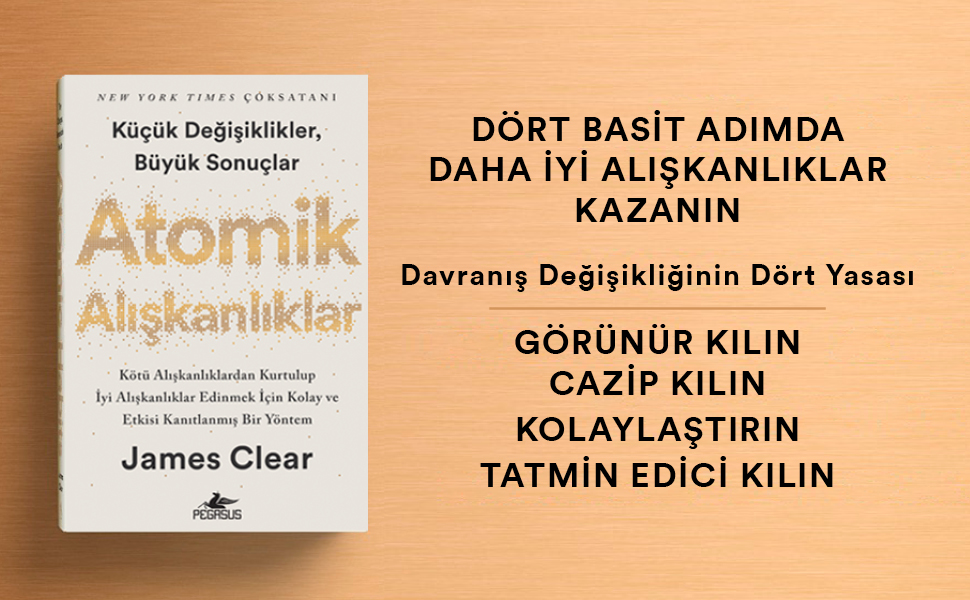
Summary and Analysis of Atomic Habits. “Your habits are the architects of your identity.” In his globally acclaimed book, *Atomic Habits*, James Clear proves that great change comes not from revolutionary decisions, but from small, sustainable steps. So, is it possible to completely transform your life with just the 1% rule? In this article, we will explore the scientific ways to break bad habits and establish an unshakeable system.
The Power of Habits: The 1% Rule
- Mathematical Truth: If you improve something by 1% each day, you will be 37 times better by the end of the year.
- Conversely, if you get 1% worse each day, you will almost reach zero.
- Insight: Focus on systems, not goals. Goals determine the outcome, systems determine the process.
The Four Laws of the Habit Cycle
- Make it Visible (Sign): Spread the sign of your good habit around you (e.g., Put your sneakers by the door).
- Make it Appealing (Desirable): Connect the habit with something you enjoy.
- Facilitate (Response): Apply the “2-Minute Rule.” It should take less than 2 minutes to start.
- Make it Satisfying (Reward): Set an immediate reward when the habit is finished.
Identity-Based Habits
- According to Clear, the biggest mistake is forming “results-oriented” habits (e.g., “I want to lose 10 kilos”). Instead, be “identity-oriented”:
- Instead of saying “I want to lose weight,” say “I am a healthy person.” When making a decision, ask yourself: “What would a healthy person be doing right now?”
Frequently Asked Questions
- What does Atomic Habits explain? It explains, with scientific data, how small steps can lead to enormous results in the long run. What is the
- 2-Minute Rule? It’s about making it so easy to start a habit (e.g., reading just one page instead of reading a whole book) that your brain can’t resist it.
The Science of Habits: How Behavioral Change Occurs?
James Clear doesn’t see the formation of a habit as merely a “matter of willpower”; he defines it as a biological and psychological cycle. This cycle is the engine behind the automatic actions you perform every day.
1. Cue: Trigger Your Brain
A cue is information that tells your brain to expect a reward. In the modern world, the sound of a phone notification or seeing the cookie jar when you enter the kitchen are both cues.
- Strategy: If you want to develop a good habit, make the cue visible. If you want to read a book, put the book on your pillow.
2. Craving: The Source of Motivation
Desire is the driving force behind habit. You don’t actually crave smoking itself, but the feeling of relief it provides. Clear suggests “managing desire” here.
- Strategy: Bundle an action you need to do with an action you already enjoy (Temptation Bundling).
3. Response: Taking Action
The reaction is the actual habit you’re forming. If an action requires too much effort (cognitive load), the brain avoids doing it.
- Strategy: This is where the “2-Minute Rule” comes in. Reduce the difficulty of a habit so much that not doing it becomes harder than doing it. Aim to put on your workout clothes instead of going to the gym.
4. Reward: Complete the Cycle
The ultimate goal of every habit is reward. Reward sends a message to your brain: “It’s worth doing this action again next time.”
- Strategy: The reward for good habits is usually long-term (e.g., health). Therefore, trick your brain by adding short, immediate rewards to the process.
The Critical Concept: The Plateau Effect (The Plateau of Latent Potential)
Many people give up on a habit shortly after starting because they don’t see results. James Clear calls this the “Valley of Disappointment.” Change isn’t linear.
- The reality: You put in the effort, but for a while, nothing seems to change.
- The Breaking Point: When the habit reaches its accumulated potential, the results appear suddenly and massively. Just like an ice cube melts not when it goes from 0 to 1 degree, but when it goes from 31 to 32 degrees.
Habit Tracking and Social Proof
Clear says, “You need proof for your habits to become your identity.” Every positive action you take is a vote for the person you want to be.
- Identity Change: Your goal shouldn’t be “to run a marathon,” but “to be a runner.” A runner goes out even when it rains.
7 Strategies You Can Implement Today
You can follow these practical steps to integrate the scientific facts in this book into your life:
1.Habit Stacking: Add a new habit to an existing habit you already do every day.
- Formula: [Existing Habit] + [New Habit]
- Example: “After pouring my morning coffee (existing), I will meditate for 1 minute (new).”
2.The 2-Minute Rule: A new habit shouldn’t seem daunting. It should take less than two minutes to start.
- Example: Instead of aiming for “running for 30 minutes,” aim for “tying my running shoes.” Starting is 80% of the battle.
3.Environmental Design: Don’t rely on willpower, organize your environment.
- Atomic Habits Book Summary and Review
Example: If you want to drink more water, put a glass of water in every room of your house. The one that is visible will be chosen.
4.Habit Tracker: Don’t break the chain. Putting an X on a calendar triggers a sudden dopamine release in your brain and gives you a feeling of “achievement.”
5.Never Skip Two: It’s okay if you miss one day of your habit, but never miss a second. Missing one is a mistake, missing two is the start of a new (bad) habit.
6.Seduction Packaging: Combine something you have to do with something you want to do.
- Example: Only allow your favorite podcast to be listened to at the gym.
7.Invest in your identity: Every positive action is a **“vote”** for the person you want to be. If you read a page of a book today, you voted for “someone who is a reader.”